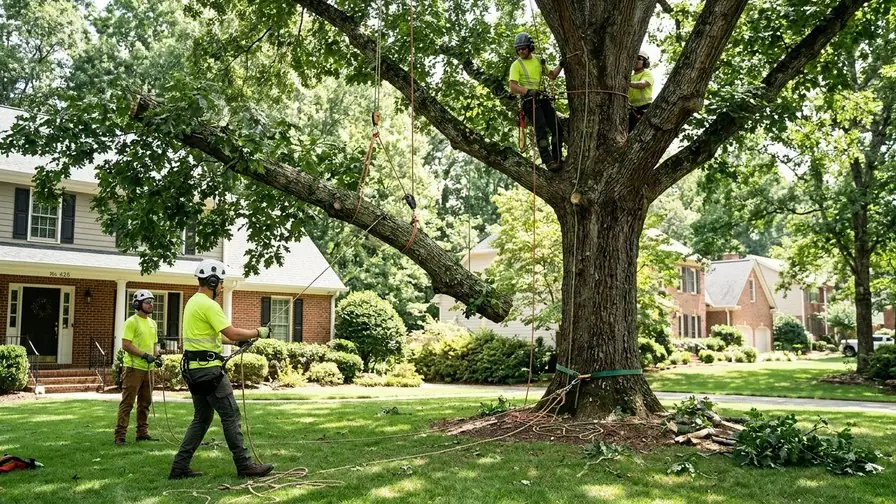
Oaks are some of the most valued trees in Roswell, and taking one down is a big decision. Sometimes trimming is enough. Sometimes it is not. This article looks at how that decision gets made and what the removal itself involves.
How do you decide whether to remove a big oak?
Deciding whether to remove a big oak comes down to its condition and what it could hit. If the trunk has major decay, large limbs are dying, a big limb has split from the trunk, or the roots were badly damaged, removal is often the safer choice near a home. A healthy oak with a few bad limbs may only need trimming. An on-site look helps weigh those options honestly.
Remove when >>
- Major decay, split leaders, widespread dieback.
Trim when >>
- A few dead or crossing limbs on a sound tree.
Weighing Trim Versus Remove
Start with the tree's overall health. A dense, green crown with a few dead branches can often be trimmed and kept. A crown with large areas of dieback, sparse leaves and many dead limbs is a tree in serious decline.
Next, consider structure. A large limb that has split from the trunk leaves a wound that can let decay in. Cavities and shelf fungi on the trunk suggest internal rot. Finally, think about roots. Oaks are sensitive to soil compaction and grade changes, so a tree near recent construction may decline over several years. Combine all three with the target below, and the answer usually becomes clear.
Why Oaks Need Heavy Rigging
Oak wood is dense. A single big limb can weigh hundreds of pounds or more. That is why crews keep pieces small and use strong rigging when lowering them.
In Horseshoe Bend and other wooded parts of Roswell, oaks often stand close to houses with mature landscaping below. That means more lowering and less dropping. When a limb hangs right over the roof, a crane can hoist it away.
After the Oak Is Gone
Oak makes long-burning firewood, and some homeowners keep it. The rest is chipped and hauled.
Oak stumps are often wide, so grinding may be its own line on the quote. The open space can be replanted with a new tree a short distance from the old spot.
A Thoughtful Decision
Losing a big oak is never easy, but safety comes first. Call us, tell us what you are seeing in the tree, and we will connect you with a local provider who can help you decide.
Questions Roswell Homeowners Ask
Can a damaged oak be saved instead of removed?
A damaged oak can sometimes be saved if the damage is limited to a few limbs and the trunk and roots are sound. Trimming broken wood and, in some cases, cabling weak joints can help. Extensive decay or a split trunk usually means removal is safer.
Why are oak limbs so heavy?
Oak limbs are heavy because oak is a dense hardwood that holds a lot of moisture when alive. Large limbs can weigh far more than they look. That weight is why oak removals use strong rigging, short sections and sometimes a crane.
Can I replant where an oak was removed?
Yes, you can replant after an oak is removed. Grind the stump deep enough for the new tree's roots, or plant a little to one side of the old stump. Choosing a species suited to the spot and its distance from the house helps avoid future problems.